

At our Divine Service this Sunday, Peter reflected on the profound meaning of Pentecost, also known as Whitsunday, and its continuing spiritual significance for Christians and Christian Spiritualists alike.
Six weeks after Easter, Pentecost marks another great turning point in the Christian calendar. Easter celebrates new life and resurrection, while Pentecost commemorates the moment when the Holy Spirit was poured out upon humanity. It is often regarded as the birth of the Christian Church and remains deeply important within Christian Spiritualism because it speaks directly of spiritual connection, divine inspiration, and God’s continuing presence among people.
Peter reminded us that throughout the weeks following Easter, many of the church readings had focused on love. This is no coincidence. Love lies at the heart of Christ’s teachings and remains God’s commandment to humanity. Yet human beings often struggle to live fully in love and compassion. Pentecost represents God strengthening humanity spiritually, refreshing the soul and renewing that divine connection.
One of the key themes explored was the idea that God is always present with us, whether we consciously recognise it or not. Pentecost demonstrates that the spirit of God exists within every individual. Peter described this as the awakening and strengthening of our inner spiritual nature.
Speaking in Tongues and Spiritual Communication
The Bible passage for the service came from the Book of Acts, where the disciples receive the Holy Spirit and begin speaking in different languages so that people from many nations could understand them.
Peter reflected on the deeper spiritual meaning of this event. Rather than focusing purely on spoken language, he suggested that God communicates directly to the spiritual heart. Spiritual communication transcends ordinary speech and can come through intuition, dreams, inspiration, feelings, and inner knowing. He explained that spirit communication does not depend upon earthly language in the way humans normally understand it.
This interpretation resonates strongly within Christian Spiritualism, where many believe that divine guidance and spiritual experiences continue today through prayer, healing, inspiration, dreams, mediumship, and personal revelation.
Peter also spoke about the importance of readiness. Spiritual awareness often unfolds gradually, and many people may not immediately recognise their connection with God. Yet the divine link is always present within the soul, waiting for the right moment to awaken.
The Bible Reading – Acts 2:1-21
The main scripture reading came from the Book of Acts:
“All of them were filled with the Holy Spirit and began to speak in other tongues as the Spirit enabled them.”
- Acts 2:4
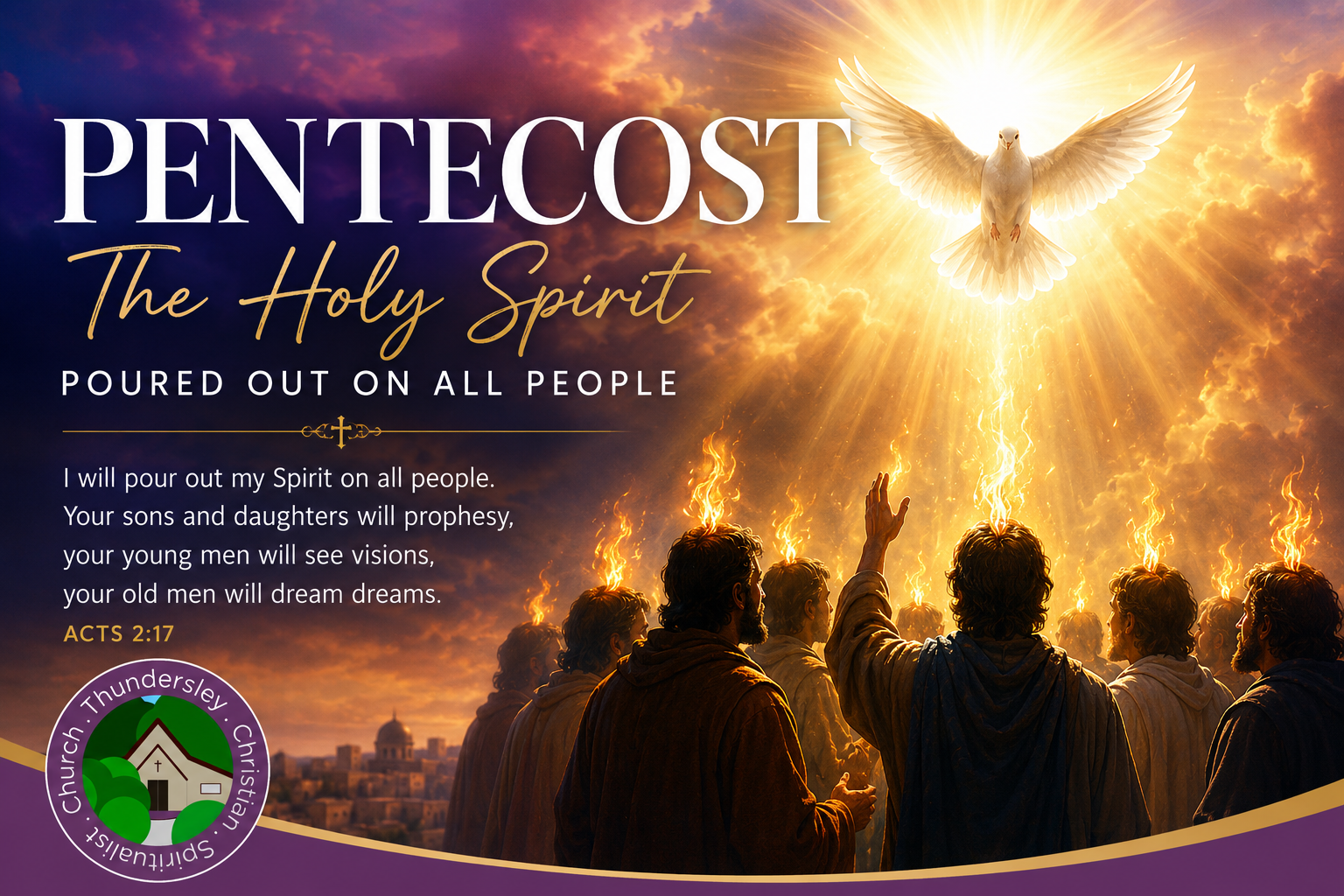
The passage describes how the disciples were gathered together when a mighty rushing wind filled the house and tongues of fire appeared above them. People from many nations heard the disciples speaking and were astonished because each heard the message in their own language.
Some mocked the disciples, accusing them of drunkenness, but the Apostle Peter stood and explained that this event fulfilled the prophecy spoken by the prophet Joel:
“I will pour out my Spirit on all people. Your sons and daughters will prophesy, your young men will see visions, your old men will dream dreams.”
- Acts 2:17
This powerful prophecy remains one of the most spiritually significant passages in Christianity because it declares that divine inspiration is not limited to a select few. God’s Spirit is available to all people.
Pentecost and Christian Spiritualism
For Christian Spiritualists, Pentecost carries a particularly meaningful message. It demonstrates that spiritual gifts did not end in biblical times. The experiences of visions, prophecy, spiritual inspiration, dreams, healing, and divine communication described in scripture are viewed as ongoing aspects of humanity’s relationship with God.
Pentecost reminds us that spirituality is not something distant or unreachable. God’s Spirit continues to work through ordinary people, bringing comfort, wisdom, healing, and love into the world.
As Peter concluded during the service, spiritual experiences come when people are ready to receive them. Through prayer, worship, compassion, and openness to spirit, individuals may deepen their awareness of God’s presence in their lives.
Read more: What is Pentecost? And Why Does it Matter to Christian Spiritualists?