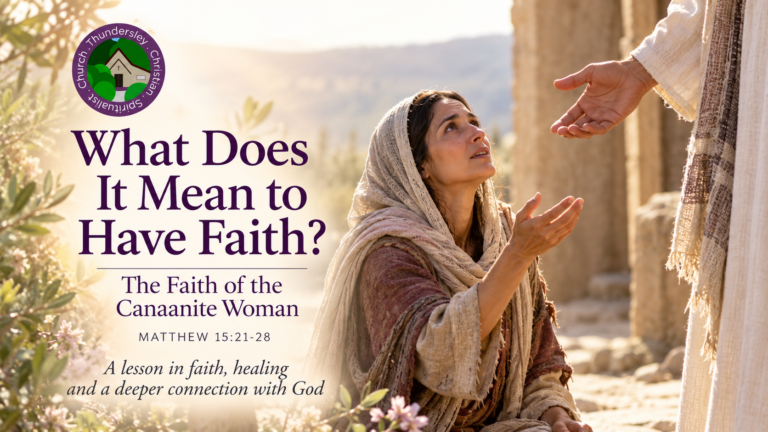



Faith, it is said, can move mountains. More profoundly still, faith can compress the largest burden into something light enough for God’s love to carry away. Yet faith is not simply wishful thinking. It is not passive hope. It is a living connection.
Last week, we explored the nature of spirit — our spiritual selves, the divine essence within us, and the pure Spirit of Christ. Jesus taught:
“All that belongs to the Father is mine. That is why the Spirit will receive from me what he will make known to you.”
“What I do, you shall do also.”
These words remind us that through Christ, great gifts flow from God to humanity. Among the most cherished within our Church is the gift of healing.
The Bible contains many accounts of healing. Each carries a specific message. Yet woven through every story is one essential thread: faith. Faith in Christ — our link to God — is central. And while that may sound simple, faith is often more fragile than we care to admit. Sometimes it resembles hope rather than certainty, and hope can falter.
Healing, in its deepest sense, involves two participants: the one who seeks healing and the one who serves as instrument. Both must make that inward link through the Spirit to Jesus Christ, the great healer. Jesus himself said:
“It is not I who do the work, but the Father who works through me.”
This truth keeps healing grounded in humility. The power is not human. It flows from God.
To reflect on faith, we turn to two well-known scriptural accounts.
The first is the story often called The Sick Woman, found in Mark 5. The second is the account of the Roman centurion who asked Jesus to heal his servant. In both stories, faith operates in different but equally powerful ways.
The centurion considered himself unworthy to have Jesus enter his home. Yet he believed completely that Christ could heal from a distance. His faith rested not in ritual, nor in proximity, but in trust.
The woman in Mark 5 demonstrates another kind of faith — persistent, personal, and courageous.
She had suffered from bleeding for twelve years. During that time, she endured great hardship under many doctors. She had spent everything she possessed, yet her condition only worsened. Physically weakened, financially drained, and socially isolated, she had little reason to expect change.
But she had heard of Jesus.
Somewhere within her, faith stirred. She believed that if she could just touch his cloak, she would be healed.
The Gospel tells us:
A large crowd followed and pressed around him. And a woman was there who had been subject to bleeding for twelve years. She had suffered greatly under the care of many doctors and had spent all she had. Yet instead of getting better, she grew worse. When she heard about Jesus, she came up behind him in the crowd and touched his cloak, because she thought, “If I just touch his clothes, I will be healed.” Immediately, her bleeding stopped and she felt in her body that she was freed from her suffering.
At once Jesus realised that power had gone out from him. He turned round in the crowd and asked, “Who touched my clothes?”
The disciples answered, “You see the people crowding against you, and yet you ask, ‘Who touched me?’”
But Jesus kept looking round to see who had done it. Then the woman, knowing what had happened to her, came and fell at his feet, trembling with fear, and told him the whole truth.
He said to her, “Daughter, your faith has healed you. Go in peace and be freed from your suffering.”
Notice what Jesus says. He does not say, “My power healed you.” He says, “Your faith has healed you.”
Faith was the bridge.
This story is not simply about physical healing. It is about connection. It is about the courage to reach out when everything else has failed. It is about recognising that healing flows through relationship — relationship with Christ, and through Christ, with God.
Scripture reminds us that spiritual gifts have been given to us as well. These gifts are signs of our spiritual nature. They are not reserved for a few. They are present within each of us, waiting to be recognised, nurtured, and shared.
We discover them through stillness. Through quiet thought. Through listening to the inner voice — the Christ within. That divine link does not disappear. The Lord Jesus does not abandon us. The connection remains available, even when our awareness wavers.
Faith, then, is not blind optimism. It is conscious alignment. It is choosing to trust in the unseen current of divine love that runs beneath every circumstance.
The woman reached out in faith — and in doing so, she demonstrated something remarkable. She did not ask publicly. She did not demand attention. She simply believed.
And belief, when rooted deeply enough, transforms reality.
Faith is not always loud. Sometimes it is a quiet touch in a crowded world.
And sometimes, that is enough.
Transcribed and edited from Peter’s In-Church Bible reading on 8th February 2026. Featured image generated by OpenAI DALL-E.