

By Peter,
Tonight’s Bible reading is a short one, but I believe it carries a particularly powerful message about faith, healing and our spiritual wellbeing.
Over the past few weeks, we have been looking at examples of faith in the Bible, and there are many of them. In our church, we regularly ask for the blessing of healing, both for ourselves and for others. We practise absent healing and hands-on spiritual healing, and faith plays an important part in both.
But this raises a much bigger question for me: what actually is faith, and how does it work?
How do we know when we are truly demonstrating faith rather than simply expressing a desire for something to happen? When we pray for healing, how do we make that spiritual connection?
Making Our Connection With God
In many of our recent readings, we have tried to understand the meaning of spiritual truth and the basis of our spiritual being. We have considered how healing involves faith and belief in Christ, who provides our link with God.
But how do we make that link?
It seems to me that when we talk about a link, we are describing a connection between two or more beings. If we think of the healer and the person receiving healing as one side of that relationship, then the other connection is with God through Jesus Christ.
Christ does not leave us. His love and care remain available to us, but we must also try to do our part. For me, that means trying to live our lives according to the path demonstrated by Jesus Christ.
Of course, we will make mistakes. We are human. But Christ teaches us about forgiveness and the enduring love of God for each one of us.
It is when we quieten our minds and become receptive to that love that we can begin to recognise our spiritual connection.
The Faith of the Canaanite Woman
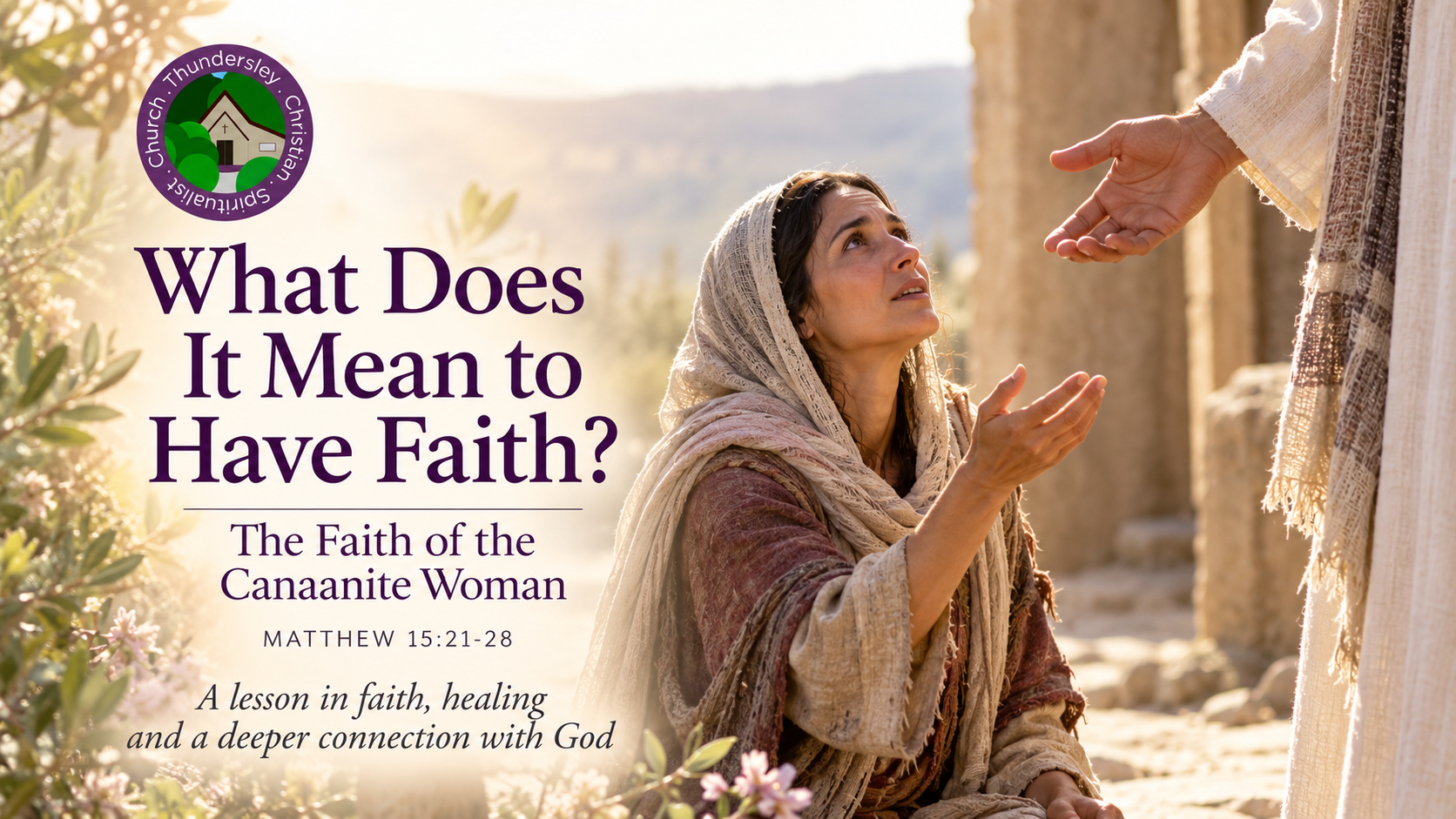
Tonight’s reading, Matthew 15:21-28, helped me think further about what it means to make that connection with God.
The passage tells us that Jesus withdrew to the region of Tyre and Sidon. A Canaanite woman approached him and cried out for mercy because her daughter was suffering terribly.
At first, Jesus did not answer her. His disciples wanted him to send her away because she continued calling after them.
Jesus then said that he had been sent to the “lost sheep of Israel”.
But the woman did not give up.
She came before Jesus and pleaded simply, “Lord, help me!”
Jesus replied with a difficult statement, saying that it was not right to take the children’s bread and throw it to the dogs.
The woman responded that even the dogs eat the crumbs that fall from their master’s table.
Jesus then recognised what lay behind her words:
“Woman, you have great faith! Your request is granted.”
Matthew tells us that her daughter was healed at that moment.
What Can We Learn From Her Faith?
I have read this passage on previous occasions and have sometimes struggled to understand exactly what it was telling me. Even now, translating spiritual teachings into our everyday lives is not always straightforward.
The “lost sheep of Israel” can be understood as those who have lost their spiritual way and need guidance back towards God.
I also see significance in the reference to bread. Elsewhere in the Bible, bread becomes a powerful spiritual symbol, particularly when Jesus describes himself as the “bread of life” in John 6:35. For me, bread can therefore represent spiritual nourishment and truth.
The Canaanite woman understood that even those seemingly outside the immediate circle to whom Jesus had been sent could still receive God’s blessing. She did not demand anything. She remained humble, persistent and certain in her faith.
Jesus recognised that faith and granted her request.
Faith Is More Than Wanting Something
This is perhaps one of the most important lessons I take from this passage.
There is a difference between wanting something to happen and having faith.
When we ask for healing, help or guidance, it is natural to want a particular outcome. But faith asks something deeper of us. It involves trust in our spiritual relationship with God even when the answer is not immediate or when we do not fully understand what is happening.
The Canaanite woman was challenged. She could have walked away when Jesus initially remained silent. She could have become angry or lost hope when confronted with his difficult response.
Instead, she remained steadfast.
Her faith was demonstrated not simply by what she asked for, but by how she responded when her request was not immediately answered.
Faith, Healing and the Quiet Mind
For those of us involved in spiritual healing, I think there is something particularly important here.
Healing is not simply about saying the right words or wanting somebody to become well. We seek to quieten ourselves, open our hearts and make that connection with God.
Faith is part of that connection.
We may not always understand how healing works. We may not always receive the outcome we hoped for. But we can continue to develop our spiritual understanding, follow the teachings of Christ and make ourselves receptive to God’s love.
The story of the Canaanite woman reminds us that genuine faith can persist even when it is challenged.
Perhaps that is one of the ways we recognise faith within ourselves. It is not only present when everything is going as we wish. Faith remains when we are tested, when we have questions and when the answer has not yet come.
God sees beyond our words and into our hearts.
And, like the Canaanite woman, we can continue to reach out in faith.
God bless.
Bible References
The principal reading is Matthew 15:21-28 – The Faith of the Canaanite Woman.
The reference to Jesus as the “bread of life” comes from John 6:35, where Jesus says: “I am the bread of life.”
This article was drafted with Chat GPT AI from a transcript of Peter’s bible reading. Edited by Humans. Featured image created by Chat GPT.