

Over recent weeks, we have explored several important areas of Jesus’ teachings during His life on Earth. We have considered what it means to have faith in the Son of God and reflected on the unity of the Body of Christ. This week’s reading takes us naturally forward to another of Jesus’ most powerful teachings: the Vine and the Branches.
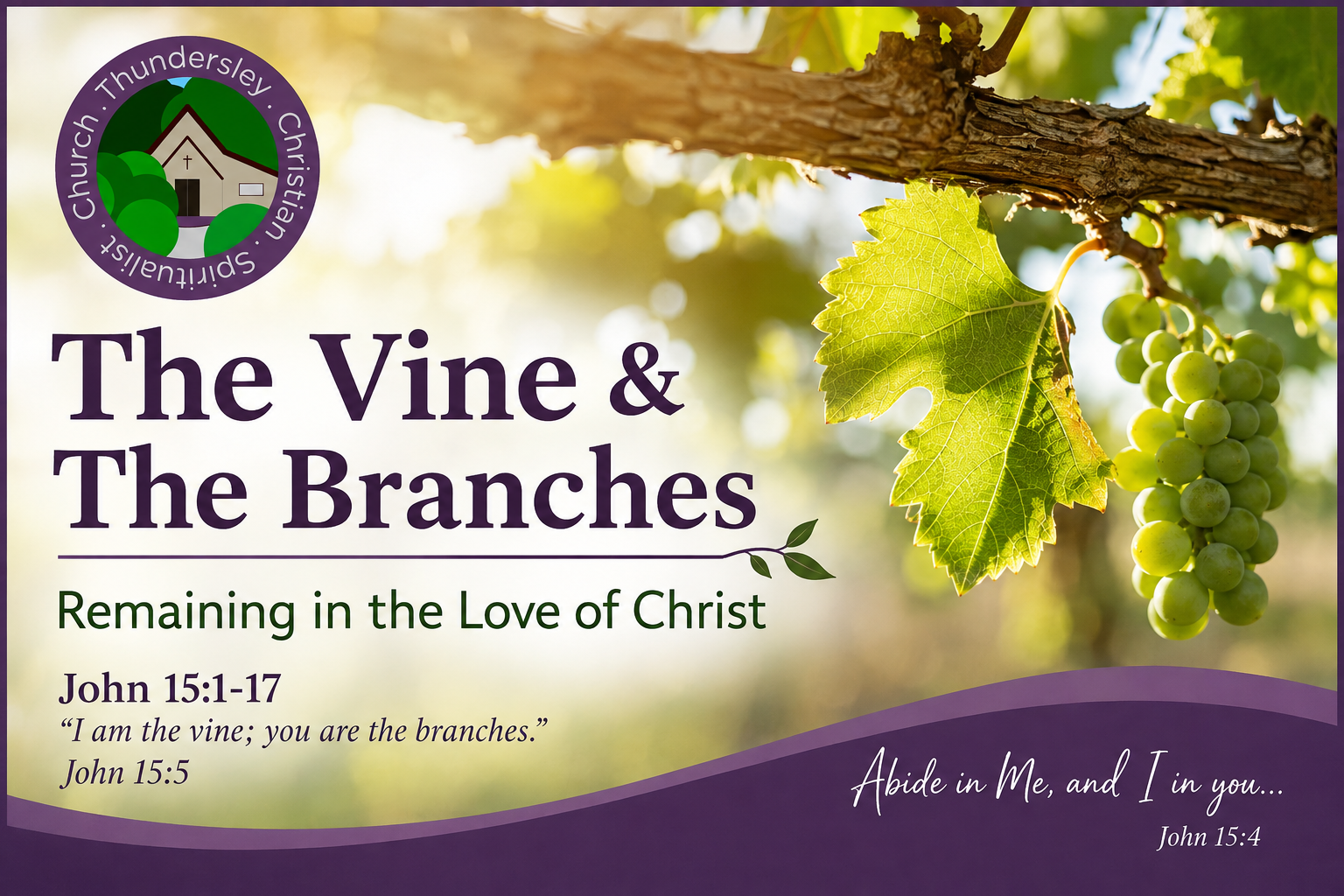
Our reading comes from John 15:1-17, where Jesus uses the familiar image of a vine, its branches and a gardener to explain our relationship with Him, with God and with one another.
To me, this passage provides a particularly significant summary of Jesus’ teaching. St John captures beautifully the closeness that can exist between Christ and the human soul. It is not simply about following Christ from a distance. Jesus speaks of us remaining in Him and of Him remaining in us.
“I Am the True Vine”
Jesus begins:
“I am the true vine, and my Father is the gardener.”
John 15:1
Jesus often used images from nature and everyday life to communicate spiritual truths. Here, the symbolism is wonderfully simple. God is the gardener, Christ is the vine and we are the branches.
A branch does not exist independently of the vine. It receives what it needs through its connection to the vine, and it is through that connection that it can grow and eventually bear fruit.
Jesus makes this relationship clear:
“I am the vine; you are the branches.”
John 15:5
For me, this is also an image of our spiritual unity. We may appear to be separate individuals, just as the branches of a vine appear separate, but spiritually we are connected through Christ and ultimately through God.
It reminds us of the importance of gentleness, brotherhood, kindness and love in the way we treat one another.
What Does It Mean to Bear Fruit?
Jesus speaks repeatedly about branches bearing fruit. Those which bear fruit are pruned by the gardener so that they may become even more fruitful.
We should therefore ask ourselves: what kind of fruit are we producing through our lives?
I understand this fruit to include truth, love, joy, kindness and happiness. It is found in the way we treat others, the choices we make and the love that we bring into the world.
Jesus tells us:
“If you remain in me and I in you, you will bear much fruit.”
John 15:5
Our spiritual development is not simply about what we believe. It should become visible through the lives that we lead.
Just as a healthy branch produces fruit, a healthy spiritual life should produce something worthwhile for others.
Pruning and Spiritual Growth
The passage also contains a more challenging image. Jesus describes the gardener pruning the branches that bear fruit and removing those that do not.
I see this as an important part of our spiritual development. Throughout life we make mistakes. Sometimes our actions are loving and compassionate, while at other times we may act selfishly or even cruelly.
Spiritual growth requires us to recognise those things within ourselves that need correcting.
When we recognise a mistake and genuinely correct it, we need not continue carrying it with us. We can learn from it, change our behaviour and move forward.
Within our understanding as Christian Spiritualists, this also relates to the principle of personal responsibility and the consequences of our actions. We cannot simply escape the effects of what we do. Where lessons remain unlearned, further opportunities for spiritual growth and correction may be necessary.
The pruning of the vine can therefore be understood not simply as punishment, but as a process of purification, learning and development.
Remaining in Christ
At the heart of this passage is Jesus’ repeated instruction to remain in Him.
A branch separated from the vine cannot continue to flourish because it has been separated from its source. In the same way, Jesus teaches that our spiritual lives depend upon maintaining our connection with the Divine.
He says:
“Apart from me you can do nothing.”
John 15:5
Remaining in Christ means more than simply calling ourselves Christians. It means trying to live according to His teaching and allowing His example to shape our relationships, decisions and actions.
Through that relationship we open ourselves to love, peace and spiritual joy.
Jesus tells His disciples that He has given them these teachings so that His joy may be within them and that their joy may be complete.
Christian spirituality should therefore not be something cold or burdensome. At its heart is love, relationship and joy.
“Love Each Other as I Have Loved You”
The passage reaches its central message when Jesus tells us exactly what He expects from His followers:
“My command is this: Love each other as I have loved you.”
John 15:12
And again, at the end of the passage:
“This is my command: Love each other.”
John 15:17
Everything comes back to love.
Our connection with Christ should change the way we relate to other people. If we claim to remain in Christ, then the fruit of that relationship should be visible in our compassion, forgiveness, kindness and willingness to help others.
Jesus even describes the greatest expression of love:
“Greater love has no one than this: to lay down one’s life for one’s friends.”
John 15:13
Love, in this sense, is much more than an emotion. It involves service, sacrifice and putting the wellbeing of others alongside our own.
From Servants to Friends
There is another beautiful part of this reading that can sometimes be overlooked.
Jesus tells His disciples that He no longer calls them servants. Instead, He calls them friends.
A servant simply follows instructions. A friend shares in a relationship.
Jesus tells His disciples that everything He has learned from the Father He has made known to them. There is a closeness here between God, Christ and humanity.
Once again, we return to the image of the vine.
God is the gardener. Christ is the vine. We are the branches.
We are connected.
Living to Love in the Spirit
There is far more contained within John 15 than can be explored in one short reflection, but for me its message can be summarised quite simply.
The purpose of our life is that we may live to love in the Spirit, and that the Divine breath of Spirit may live within us.
When we remain connected to Christ, we should bear spiritual fruit. We should become more loving, more compassionate, more joyful and more conscious of our relationship with one another.
And perhaps that gives us a simple question to carry with us into the week ahead:
What fruit are we bearing through the way we live our lives?
If our lives are rooted in love, then through our words, actions and relationships we can become branches through which the love of God reaches others.
God bless.
This article was drafting using Chat GPT AI from a transcript of Peter’s bible reading on Sunday. Edited by Humans. Featured image generated by Chat GPT.