

On this second Sunday after Easter, we gathered in a full and vibrant church, reminded not only of the physical presence around us, but of the unseen, those in spirit who walk alongside us always. As we reflect on the resurrection, we are challenged once again by a familiar but profound difficulty: truly accepting that our loved ones have not ended, but have moved into a higher realm of life.
This tension between belief and doubt sits at the heart of the evening’s reading: the account of Jesus and the Miraculous Catch of Fish. It is a story rich with symbolism, questions, and spiritual significance, far beyond its surface narrative.
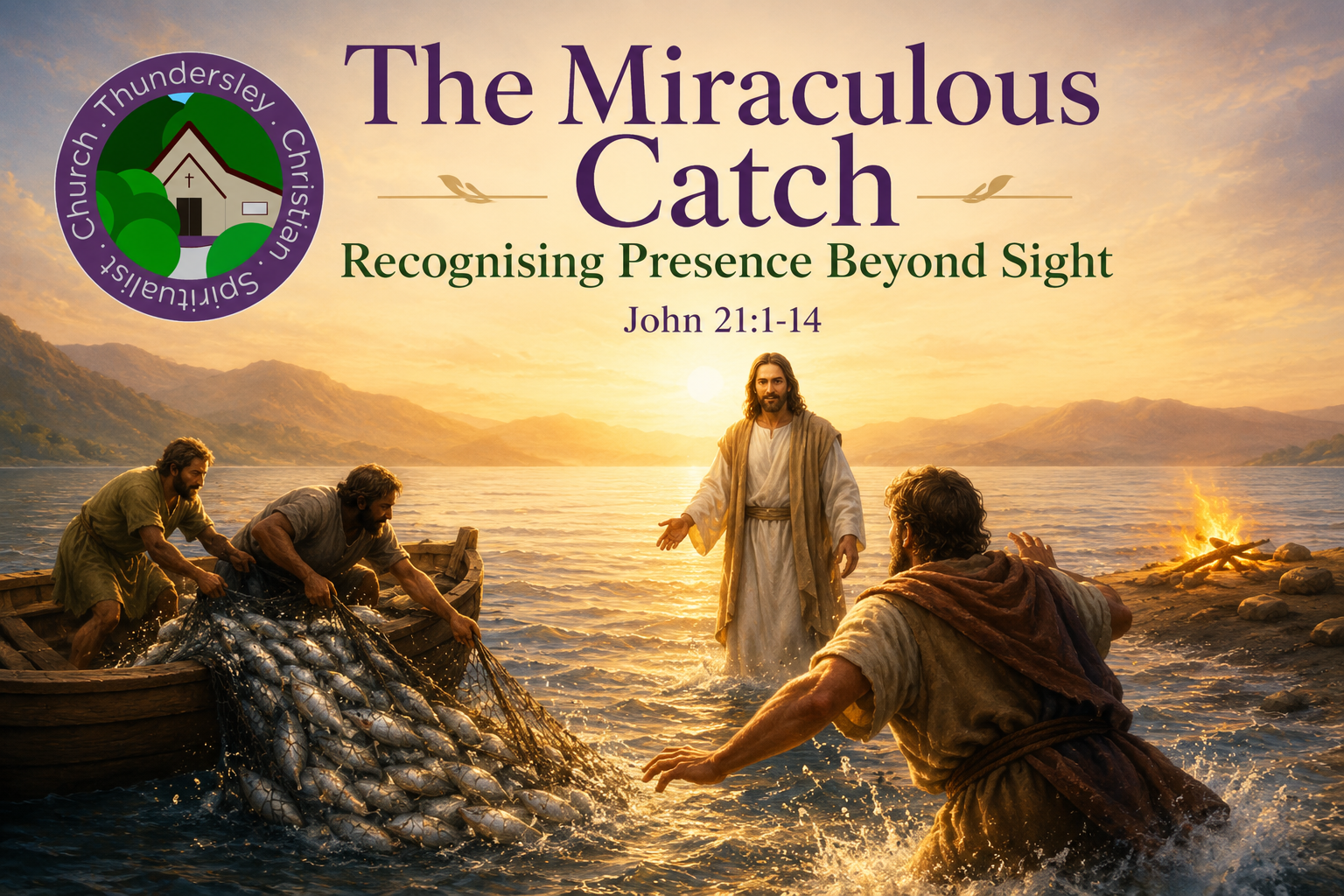
After the resurrection, Jesus appears again to his disciples by the Sea of Galilee. They are not in a state of clarity or purpose, but instead return to what they know, fishing. Despite their efforts, they catch nothing through the night. It is only at dawn, when instructed by a figure they do not immediately recognise, that their fortunes change. By casting their nets on the right side, they are suddenly overwhelmed with abundance.
This moment is telling. It is not merely about obedience or miracle, it is about recognition. Even in the presence of the divine, the disciples initially fail to see. It takes trust, action, and ultimately spiritual awareness to realise who stands before them.
Peter’s reaction is equally significant. Upon recognising Jesus, he does not hesitate,he leaps into the water to reach him. This impulsive act reflects a deep yearning for connection, a reminder that when we truly perceive spiritual truth, it demands a response.
Yet the questions remain and they are meant to.
Why did Jesus return again after the resurrection? Why instruct them to cast their nets to the right? Why the precise number of fish recorded? Why a simple breakfast shared on the shore?
These are not incidental details. They invite contemplation. The number itself, the act of gathering, the breaking of bread, all echo themes of unity, provision, and spiritual nourishment. The breakfast on the beach becomes more than a meal; it is a form of communion, a quiet yet powerful reaffirmation of presence and continuity beyond death.
For us today, the message is direct. Like the disciples, we often fail to recognise spiritual presence in our lives. We seek proof, certainty, something tangible. Yet the evidence may already be there, in moments of guidance, in sudden clarity, in the quiet reassurance that we are not alone.
The resurrection was never intended to be a single event confined to history. It is a living truth, unfolding continuously. It challenges us to shift our perception, from seeing only the physical, to recognising the spiritual reality that surrounds us.
As we move through the coming week, these questions are worth holding onto. Not to solve immediately, but to sit with. Because in that space of reflection, understanding begins to grow.
And perhaps, like the disciples on the shore, we may come to recognise that what we are searching for has been with us all along.
📖 Gospel of John — Chapter 21, verses 1–14
This blog was written with the help of ChatGPT from a Transcript of Peter’s bible reading on Sunday 12th April 2026. Edited by Humans. Featured image generated by ChatGPT.