


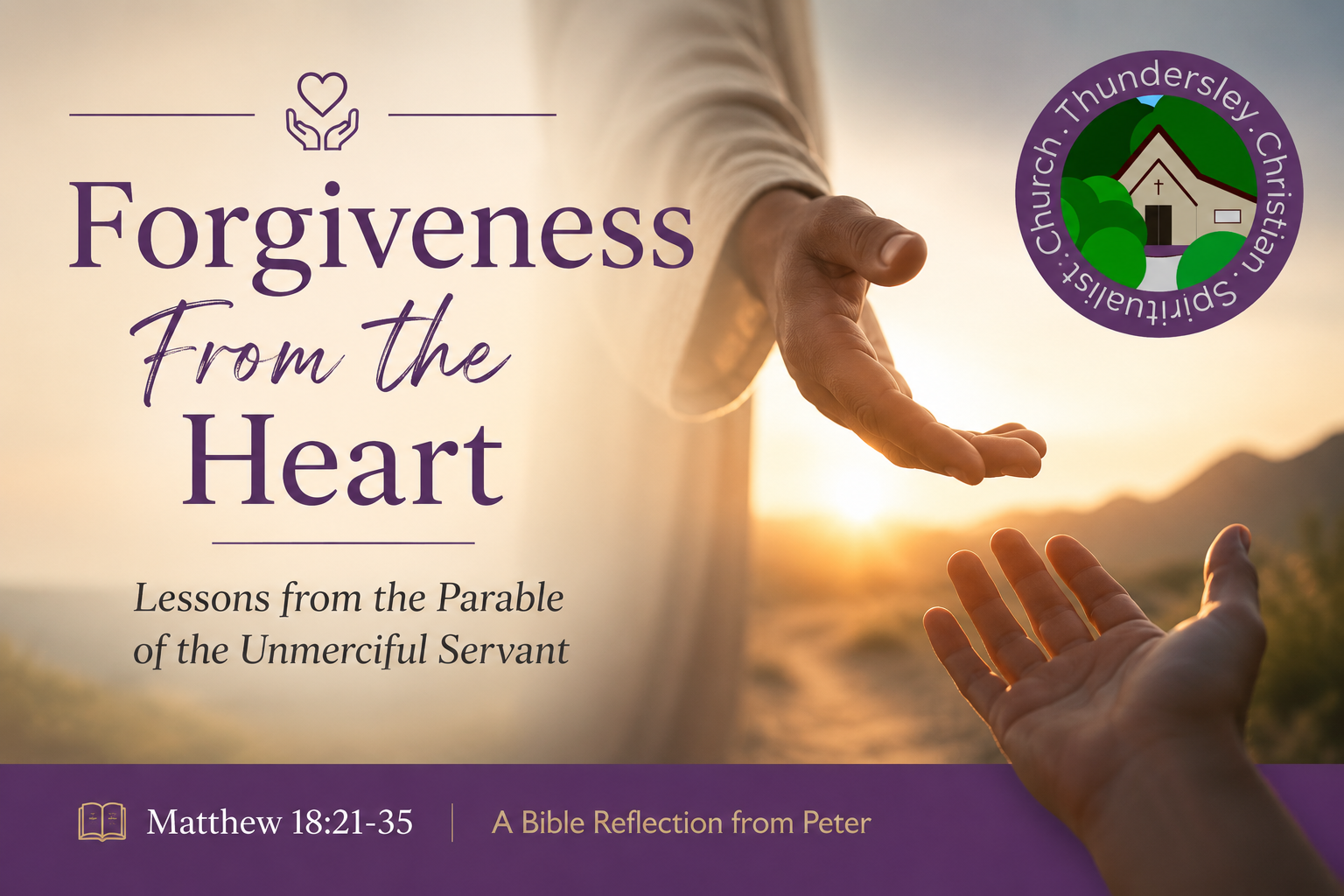
Bible Reading: Matthew 18:21-35
At this week’s Divine Service, Peter shared one of Jesus’ most challenging and thought-provoking parables – the Parable of the Unmerciful Servant, found in Matthew 18:21-35.
This passage begins with a question asked by Peter:
“Lord, how many times shall I forgive my brother or sister who sins against me? Up to seven times?”
Jesus answered:
“I tell you, not seven times, but seventy-seven times.”
Matthew 18:21-22 (NIV)
It is a powerful reminder that forgiveness is not something we measure or limit. Instead, it should become part of who we are as followers of Christ.
Looking Beneath the Surface
When we read Scripture, it is important not simply to read the words, but to seek the deeper spiritual meaning behind them.
Last week we reflected on the Lord’s Prayer, comparing the accounts in Matthew and Luke. Although the wording differs slightly, each version helps us understand Christ’s teaching more fully.
Luke speaks of the forgiveness of sins, whilst Matthew refers to the forgiveness of debts. Within our Christian Spiritualist tradition, we also commonly use the word trespasses, reminding us that our actions, words and attitudes can cross into the rights and wellbeing of others.
All three expressions point towards the same spiritual truth. Whenever we fail to live according to God’s commandment to love one another, we create a debt of love that requires repentance, forgiveness and reconciliation.
Jesus taught:
“Love your neighbour as yourself.”
Matthew 22:39
This means striving never to cause harm through our words, our actions or our intentions.
The Meaning of the Unmerciful Servant
The parable tells of a servant who owed his master an enormous debt that he could never hope to repay. When he pleaded for mercy, the master compassionately cancelled the entire debt.
Yet shortly afterwards, that same servant encountered a fellow servant who owed him a comparatively tiny amount. Instead of showing the same mercy he had received, he demanded immediate payment and had the man imprisoned.
When the master discovered what had happened, he condemned the servant’s hypocrisy.
Jesus concludes with these sobering words:
“This is how my heavenly Father will treat each of you unless you forgive your brother or sister from your heart.”
Matthew 18:35 (NIV)
The message could hardly be clearer. We cannot expect mercy while refusing to show mercy ourselves.
Forgiveness Requires a Change of Heart
One point I believe is often overlooked is that forgiveness does not ignore wrongdoing.
God’s love is limitless, but true forgiveness is closely connected with repentance. Repentance means recognising where we have fallen short and making a genuine effort to change our behaviour.
Forgiveness is therefore not simply about saying the right words. It is about transformation of the heart.
As Christian Spiritualists, we understand that spiritual progress continues throughout our lives. Every experience offers an opportunity to grow in wisdom, compassion and love. Each time we choose forgiveness over resentment, we take another step forward on that journey.
A Choice for Every One of Us
As I reflected on this passage, I found myself asking an important question.
Who does the master represent?
Who does the unforgiving servant represent?
Jesus invites each of us to answer those questions personally.
We have all experienced times when we have needed forgiveness. We have also experienced moments when someone else has needed ours.
The challenge is whether we are prepared to extend the same grace that we ourselves have received.
A Message for Today
In today’s world, it is easy to become divided by disagreements, misunderstandings and hurt. The Parable of the Unmerciful Servant reminds us that the Kingdom of God is built upon mercy, compassion and forgiveness.
Forgiveness does not always mean forgetting what has happened, nor does it remove accountability where harm has been done. But it does free us from allowing bitterness to control our hearts.
When we forgive sincerely, we reflect the love that Christ has shown to each of us.
My encouragement this week is to spend time with this remarkable passage from Matthew 18:21-35. Read it prayerfully. Reflect upon it deeply. Ask yourself where forgiveness may still be needed in your own life.
When forgiveness comes from the heart, it has the power not only to heal relationships, but also to transform the soul.
Bible Reference: Matthew 18:21-35 – The Parable of the Unmerciful Servant
This article was drafted using Chat GPT AI from a transcript of Peter’s bible reading at our Divine Service on 28th June 2026.